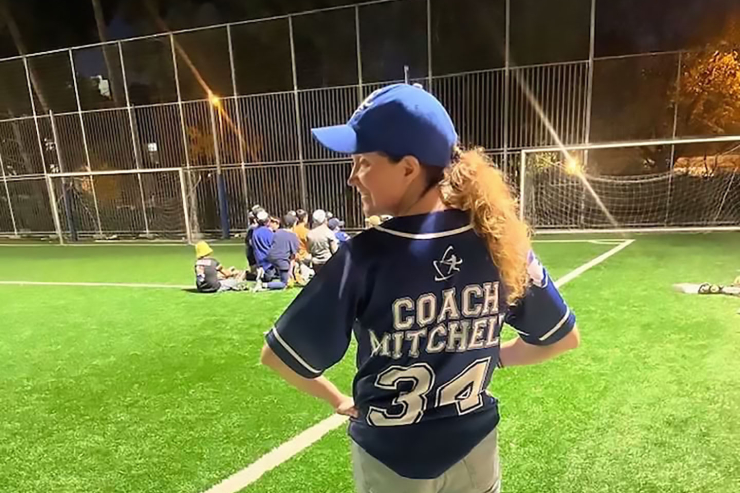
Jerusalem’s Culture Maker: Callie Mitchell
Walking down HaNevi’im Street in Jerusalem, not far from the famous Machane Yehuda outdoor market, a visitor to the Holy City could easily walk past an unmarked, locked iron gate tucked between old stone buildings. It was easy to miss — until you knew what was behind it. Callie Mitchell, who I had come to meet, sent me directions to help me find her home, on the campus of the Anglican International School. She instructed me to call when I arrived so she could come down and let me in.
I was immediately struck by two things — the incredible amount of space housing well-preserved old buildings, ones that even life-long Jerusalemites had never seen, and by Callie herself.
As Callie’s husband, Devin Mitchell, would explain when he joined us at the tail end of the interview around her wooden kitchen table overlooking the wraparound terrace that doubled as Callie’s office, we were looking out on the campus of the Anglican International School Jerusalem (AISJ), founded in 1962 by the Church’s Ministry Among Jewish People (CMJ).
Devin Mitchell, who came to Israel to teach ESL (English as a Second Language) and to serve in the Israel Defense Forces, now serves as the school’s principal. Before moving into the role — and into the house that came with it — he spent 14 years at the school as a teacher, dean of students, and head of secondary education.
The school’s own connection to Jerusalem runs deep. It traced its origins to 1847, when Bishop Samuel Gobat of Switzerland, the second Bishop of Jerusalem, opened a school in the Old City. The property itself dated to 1863, when CMJ built a sanatorium there; it later became a hospital known as Hadassah Aleph, serving as Jerusalem’s main hospital following the establishment of the State of Israel on May 14, 1948. Devin pointed out that when tours of the campus were offered, there were always Jerusalemites of a certain age who reported being born in the hospital.
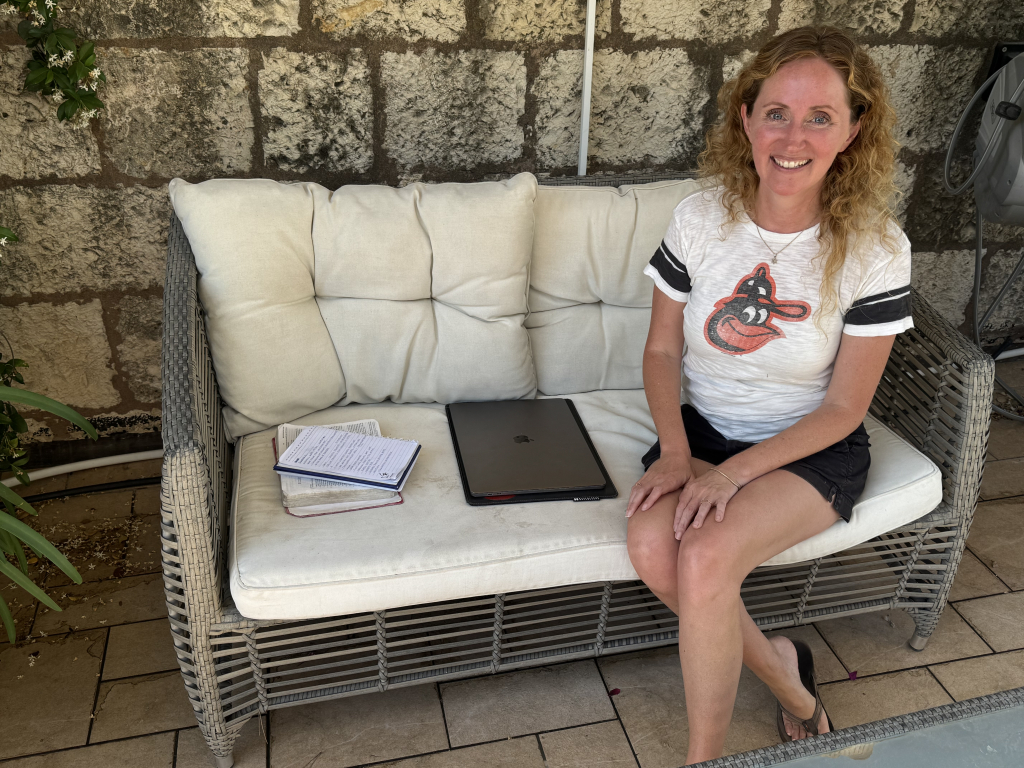
But I had come to meet Callie Mitchell (43), a blonde-haired, Israel- and baseball-loving Evangelical Christian, mother of four and a brain tumor survivor.
Callie opened the gate and greeted me in jean shorts, a Baltimore Orioles t-shirt, and a smile, playfully acknowledging that she intentionally chose the shirt with the Orioles’ “bird” for our interview — she remembered our earlier phone conversation, where I had disclosed my lifelong affinity for the Orioles. In return, I put on the special blue-and-white O’s hat with a Star of David that I had brought in my knapsack, a gift from my Baltimore-based sister, given out this season as part of Jewish Heritage Day.
It was an understatement to say Mitchell knew a thing or two about baseball. Her professional and personal experience with the game, at every level, could easily fill a memoir. But the fuller story of what she has built in Jerusalem — the program she inherited, nearly lost, and rebuilt — is where her real baseball legacy in Israel lies.
Inheriting a Challenge
Mitchell serves as the Jerusalem regional director for the Israel Association of Baseball (IAB), directing all operations for Jerusalem Lions baseball.
In her role, she has helped introduce baseball to five- to eighteen-year-olds as well as adults, and has handled the day-to-day nuts and bolts of running a baseball program in Israel — staying in touch with colleagues in Beit Shemesh, Gezer and Efrat, whose teams compete against Jerusalem’s; using her architect’s eye to turn soccer fields into workable baseball practice fields; and creatively sourcing balls, gloves and catcher’s equipment through Amazon and her family’s USA baseball connections.
But when Mitchell took over, there was not much of a program left to run.
“I took over a program of less than 30 kids, and 4 coaches. Only 2 of the 4 coaches returned my first year,” she recalled. The teams were fragmented — no sense of community, no way for families to see progression between age divisions.
There were not even enough balls to hold a practice. “We didn’t have any balls. I started the season with less than 12 balls,” she said — until boxes arrived as a donation from her father, Jerry Narron, a former MLB catcher, coach and manager with deep baseball connections to this day. He also sent a full set of catcher’s gear.
Helmets were another crisis entirely. The program had not had any the year before Mitchell took over, so she crowd-funded a set for every division through her home community in the USA, who “gave generously through the summer so we could have basic equipment.”
Even once she had scraped together equipment, the obstacles kept coming. “After October 7th, our storage shed flooded and we lost equipment due to mold.”
Once again, her father came through, this time via his close friend Paul Goldschmidt — the New York Yankees first baseman who played under Narron for the Arizona Diamondbacks in 2017 and 2018 — who covered the cost of a new shed.
The gear and shed were only part of the crisis. Behind it sat structural problems no amount of hustle could fix alone.
A turnover of IAB Regional Directors had scattered years of institutional history and resources. At some point, the amutah (Israeli nonprofit) that IAB had originally established for the Jerusalem region became inactive and closed — leaving Jerusalem’s parent leaders without an anchor point for real operational authority.
And as IAB’s National Academy program grew, Jerusalem’s relevance shrank further: academy practices, two hours away, put a hard ceiling on which local kids and coaches could participate at the national level. “The communities that were sending more kids to academy have generally had more IAB support in the past,” Mitchell noted — a gap she is still working to close.
Her colleague David Weiss, who coaches in Karnei Shomron and manages the U15 National Team, put it bluntly in her first year: “Jerusalem is where baseball goes to die.”
Mitchell laughed, recalling it. “Well, I believe in resurrection life, so we’re coming back from the dead.”
Rebuilding From the Roots
While Mitchell is skilled at using her resources, connections and charm to secure equipment, she views her job as much more than baseball operations and logistics. “I am a culture maker,” she said. “I facilitate the growth of a community so that people can make friends and put roots here.”
She playfully but sincerely credited her training as an architect — she holds a Master of Architecture degree from the University of Cincinnati — and her experience as a mom for helping her in a job that, she said, was “a little different each day.”
In her first year, before anything else, Mitchell spent much of her time simply getting to know families — understanding what they needed and identifying the small core of committed parents who would invest in the program’s future.
Community-building and player development, she said, had to move together: “I know our players will only reach their potential if we have adults committed to providing the structure and space they need to grow.”
That started with communication. “I set up WhatsApp groups, a team email and a Google Drive. I wanted to have better communication and to make sure there were at least two adults on the field at all times. And I wanted to meet the parents and find out who was committed — and to see what their needs are.”
Mitchell also organized buses for games, made sure registration and medical forms were completed properly and on time, fielded parent questions about equipment, and tracked Amazon shipping prices — a bigger deal in Israel than it sounds. Unlike with Prime membership in the USA, Amazon does not offer free shipping to Israel as a default, and between international shipping fees and Israeli import taxes, orders could get expensive fast, with free shipping only occasionally available on select items. “I look on Amazon to see what is shipping for free. When balls are being shipped for free, I buy them!”
Mitchell stressed that “the kids are the main focus of the IAB right now.” At the same time, she has not lost sight of developing homegrown talent. “We are really focusing on baseball in Israel. We want to make Israel baseball Israeli again — so local guys can play on the national team and represent Israel.”
The rebuild is paying off. “We have had 150% growth since I took over. We have gone from 30 to 75 kids playing baseball!”
This year, the Jerusalem Lions’ Little League team has been especially competitive — a result, Mitchell says, that is trickling both up and down through the program’s age divisions. Jerusalem, once written off, is proving it belongs.
A Baseball Lifer
None of this came as a surprise for a baseball lifer like Mitchell, who may well have the most impressive MLB credentials of anyone in Israel. “I went to a baseball game every day of my life from the day I was born to the day I moved to Israel in 2009.”
Mitchell honestly cannot remember her first baseball game or baseball memory. “Baseball has been life from the womb. Baseball was always home for me!”
Callie Mitchell’s family connections to baseball run deep. She humbly reported that nine of her relatives — many with the surname Narron, including her father, Jerry — have played and coached in the major leagues over the past ninety years. “The first was my great-great-uncle, Sam Narron, drafted by Branch Rickey,” the legendary baseball player, manager and team owner from the early to mid-1900s who was instrumental in breaking the color barrier by signing Jackie Robinson to the Brooklyn Dodgers organization.
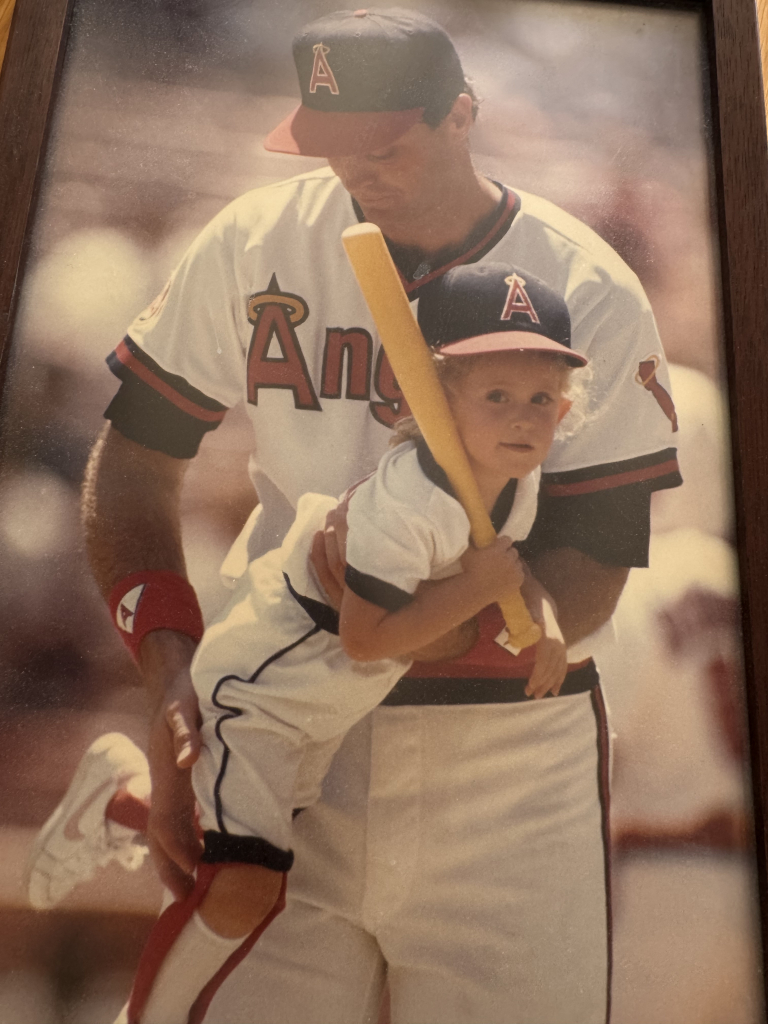
Mitchell took out a framed picture and placed it on her dining room table: her father, Jerry Narron, in 1986, holding three-year-old Callie near the pitcher’s mound at Angel Stadium in Anaheim, California. She sheepishly noted she may have been the only person in Israel who ever appeared in Sports Illustrated, which published this photo. “It’s from Family Day,” she recounted — each year, various major league teams held a day when mothers and children played a friendly game against their major league fathers and husbands.
Mitchell nonchalantly name-dropped well-known baseball figures, simply noting they were people with whom she grew up hanging out with at ballparks. “Bob Boone and the Boone brothers were my friends.” She chuckled, adding, “They were quite mischievous — they used to kick my seat!”
She also recounted hanging around a young Alex Rodriguez when he played for the Texas Rangers organization from 2001 to 2003, when her father — a longtime Rangers coach — was appointed interim manager.
Mitchell and her four younger siblings spent their childhood summers on the road with various MLB teams. While she was mostly interested in ballet, cheerleading and equestrian sports, her dad noted her “intellectual interest in baseball” from a young age, and she recalled how thrilling it was to overhear him on the phone with general managers.
Even in college, she would step away from classes to be close to her father and the game — including a memorable exchange with a professor who put together her last name and a Boston Red Sox bench coach named Narron and asked, half-joking, whether she was headed to Boston to watch the playoffs.
Mitchell admires her father as a highly respected role model on and off the field. “My dad had a 51-year career, and everyone respected his character.”
Jerry Narron was an MLB catcher for three teams from 1979 to 1987 — in his first season, serving as backup to Thurman Munson, he became the starting catcher the day after Munson died in a plane crash in August 1979. He was traded to the Seattle Mariners four months later, released in 1982, signed by the California Angels, released again in 1987, signed once more by the Mariners, and retired as a player in 1989.
He went on to coach and manage for the Orioles, Red Sox, Chicago White Sox, Rangers and Cincinnati Reds, and served as a World Baseball Classic coach for Team Israel in 2017, 2023, and 2026.
Religion has always played an important part in her father’s life and career — he was involved with “baseball chapel” throughout, where each team had a pastor for regular Bible study and work with families — and Israel has always mattered to him too.
“He really loves Israel because of his own faith,” said Mitchell, noting one of the proudest moments of his career was coaching Team Israel. He carried that role with the same humility that defined the rest of his career: “If there was an Israeli or Jew who needed his spot on the team, he would have stepped down.”
Faith, Israel, and the Work Ahead
Religion plays a similarly central role in Callie’s own life. In our conversation, she frequently reached for biblical phrases and both Jewish and Christian religious concepts. “I am a baseball evangelist,” she said. “My work is my tikkun olam (repairing the world) — baseball made my whole life make sense.”
Mitchell writes for Kindred Grace, an online community for Christian women covering faith, identity and relationships, and posts regular updates on Israel through her YouTube channel, Callie Mitchell — I Will Not Keep Silent.
Long before moving to Israel in 2009, she studied Hebrew Scripture during college at the University of North Carolina at Greensboro with a rabbi-professor who — noting how often she asked for makeup work to travel and watch her father’s teams — eventually put together the connection between her last name and a Red Sox bench coach named Narron.
Mitchell feels lucky that she and her family get to live out their life in a city and country where the Bible stories she knew and loved took place.
And for Callie, the stakes of the work go well beyond keeping a youth sports program alive. “I’m from a family of nine professional ballplayers, and I plan on producing top athletes in Jerusalem,” she said. “We’re going to have fun together, but we’re also going to work on fundamentals the correct way and be a community that truly knows the game. It will take some time, but this is where we’re going.”
She said it herself, earlier in our conversation: she is not just building a baseball program. She is a culture maker. The rest, she is convinced, will follow.
It is the same conviction that turned fewer than a dozen balls and two remaining coaches into a program chasing something bigger than survival.
“Jerusalem is where baseball goes to die,” David Weiss had once told her.
Tell that to the seventy-five kids playing in the house that Callie built — in a city that’s been rebuilding its houses for over three thousand years.
By Howard Blas, Israel Baseball News Staff
Related News & Updates
View All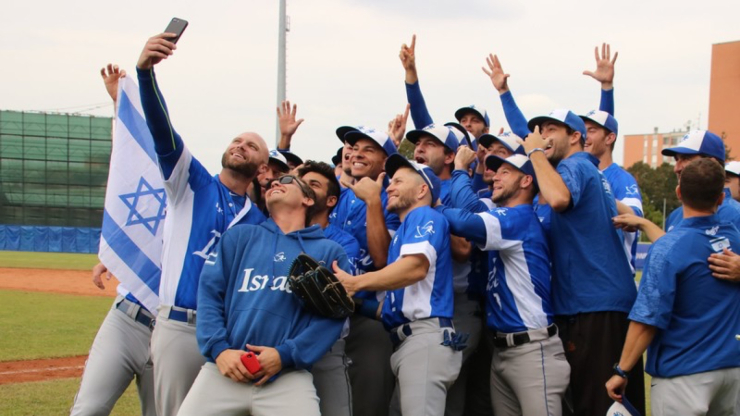
Playing for Something Greater
After years of injuries that ended his stateside career, Jon Moscot was living a dream that he never…
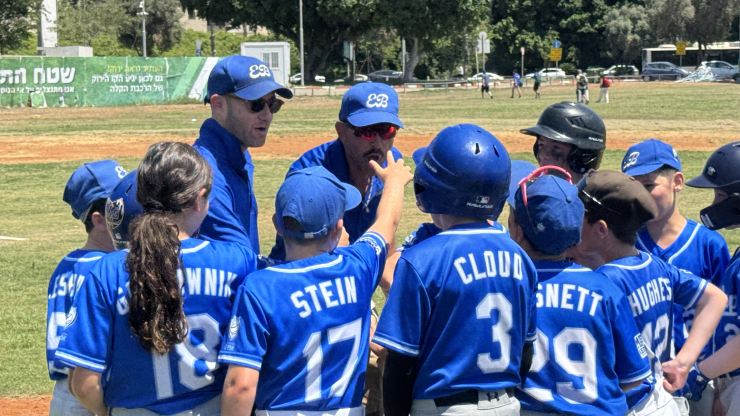
Inaugural U-12 National Tournament Showcases Baseball’s Growth in Israel
Israel Baseball hosted its Inaugural U-12 National Baseball Tournament on July 9-10 at Sportek Tel Aviv…
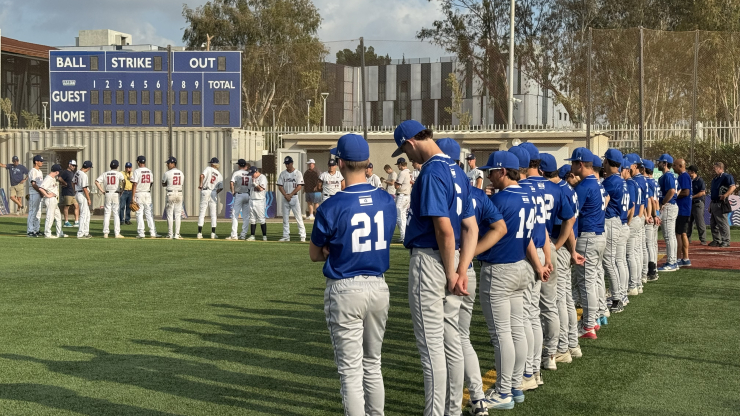
Israel Battles USA to the Brink at the 2026 Maccabiah Games
At Ezra Schwartz Memorial Field in Ra’anana, a young and deeply rooted Israel U19 squad pushed the Americans…