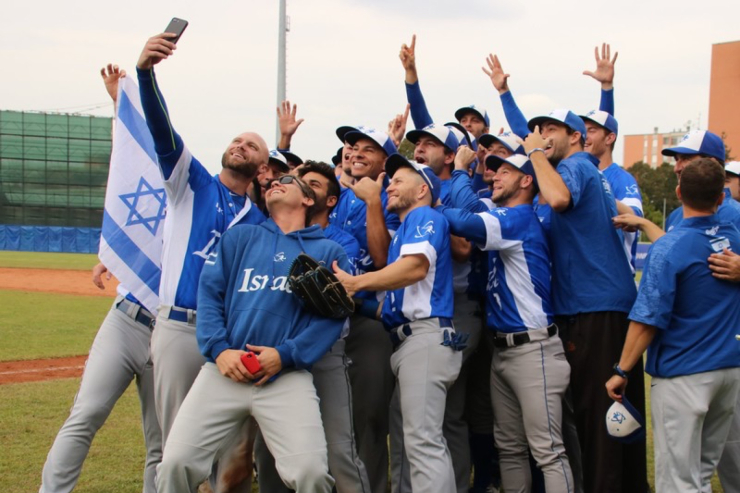
Playing for Something Greater
After years of injuries that ended his stateside career, Jon Moscot was living a dream that he never thought he’d have, becoming the first starting pitcher in Israeli Olympic baseball history. He didn’t know if his arm had one more meaningful outing left; he only knew where he wanted to spend it.
But just nine pitches into the first inning of Israel’s Olympic opener against South Korea at Yokohama Stadium in Tokyo on July 29, 2021, Moscot’s right elbow gave out again, ending his tournament almost as quickly as it began. It wasn’t a surprise. It was a possibility Moscot already had accepted.
“If I’m going to blow my arm out, at least let me do it in a game that’s meaningful,” Moscot said. “I didn’t care if my arm blew out. I know it sounds crazy. All I wanted to do was to contribute to the team and win a medal.”
Moscot’s story is unique. Most players wouldn’t willingly take the mound believing it could be the last pitches of their career. But the feeling behind it wasn’t unique. In conversations with three former Team Israel players — one a former big leaguer, one a career minor leaguer who got a brief taste of the majors, and one who never got the call at all — a common theme emerged: whatever their level of professional success, wearing an Israel jersey was not a consolation prize. For each of them, it was the most meaningful moment of their baseball careers.
“To me, it was everything to be able to put on a jersey and represent Israel and do it with all of the backdrop and all of the stuff going on behind the scenes about my health, my life, and my Judaism,” Moscot said. “It was one of the most meaningful moments of my career.”
By the time Moscot took the mound for Israel that day, he was 29 years old and over five years removed from his last affiliated action, when he split half a season between the Cincinnati Reds and Triple-A Louisville in 2016.
Southpaw Evan Kravetz was on the other end of the baseball spectrum. When Israel called ahead of the 2023 World Baseball Classic, he hadn’t yet pitched in Triple-A, let alone the big leagues. The tournament in Miami became the biggest stage of his career to that point.
“I think when Israel baseball started becoming a thing, growing up that was a dream. The conversation was like, ‘Wouldn’t it be cool if I played for Team Israel one day?’” Kravetz recalled. “That was before collegiate baseball was even in the picture, let alone professional baseball.”
With the dream of making the team fulfilled, Kravetz set about the task of facing some of the best hitters in baseball. In Israel’s group stage game against the Dominican Republic, the young lefty was called on in the second inning to face the heart of the Dominican lineup which included Juan Soto, Julio Rodriguez, Manny Machado, and Rafael Devers.
“Soto was first up and I got to the mound and (Israel manager Ian) Kinsler gave me the ball. I wanted to crack a joke just to cut through the tension a little bit. Soto was taking his practice swings, getting ready to get in the box, and I just said, ‘Anyone got anything on this guy? Haven’t really heard of him before.’ Kinsler looked at me like I was crazy. I don’t think the joke hit him immediately, but it was a lot of fun,” Kravetz recalled with a smile. “I got to pitch against over a billion dollars’ worth of contract value, which is pretty funny as a minor leaguer. I really enjoyed the experience.”
On the field, Kravetz began his outing with a strikeout of Soto. He got to keep the ball from that one. He then struck out Rodriguez before a Machado home run and a Devers single ended his outing. He finished his Israel career with 0.2 innings pitched, but he left with something greater.
“I did notice that after that I got lots of mail from young Jewish baseball players, Jewish families that were very supportive. Knowing that there’s not a huge population of Jewish athletes, I think being on Team Israel and representing a smaller community was a big deal for me, and I think we all felt that as players,” Kravetz said. “It was really just a dream.”
Kravetz eventually reached the big leagues with the Reds the following season. In his debut on August 28, 2024, he similarly got two outs before returning to the minor leagues. But he made it. And he wouldn’t trade those two outs for Israel and two outs for the Reds for anything.
“It’s kind of ironic, right? Because I was a four-year college guy. I was a senior signing, went through six years in the minor leagues, and then to say at the end of the day, all of that added up to four outs,” he said. “On the surface it sounds like you’d almost be ungrateful for it, but that couldn’t be further from the truth. It was extremely special for me, regardless of the length of it. I’d rather have thrown four outs than zero outs between these two tournaments and circumstances.”
While Moscot and Kravetz did get the call to the Major Leagues, Mitch Glasser never did. Instead, Glasser’s biggest baseball moments came in an Israel jersey. He was more than okay with that.
Drafted by the Chicago White Sox in the 39th round of the MLB Amateur Player Draft in 2012, Glasser’s affiliated career lasted just three games before he continued his career in the independent ranks. But with Team Israel, he found a stage unlike anything he experienced in professional baseball, helping the team qualify for its first World Baseball Classic in 2016 before later representing Israel with Moscot at the Tokyo Olympics.
“That was my big leagues. Being able to wear Israel across my chest, that was my everything. I felt like I could perform at the top of my ability because I was playing for something more than myself, more than just my family,” Glasser said. “I was playing for something greater. I could feel that every time I put the uniform on.”
After sparingly playing during the 2016 World Baseball Classic qualifying run, Glasser became a star for the Israeli squad during the 2020 Olympic Qualifying tournament and during the pandemic-delayed Olympics in 2021.
In Japan, Glasser started all five games for Israel and went 7-for-17 (.412) at the plate, driving in four runs, scoring four, and adding three doubles. But despite being one of the most productive members of the lineup, one of Glasser’s lasting memories is just how close the team came to a chance at a medal.
After winning their first knockout round game over Mexico, Israel needed a win against the Dominican Republic to stay alive. They led 6-5 going to the bottom of the ninth inning, but a pair of Dominican runs ended Israel’s tournament. It’s a feeling that still stings for Glasser.
“The Olympics were bittersweet because we had a real path to a medal. We were winning in the ninth inning against the Dominican Republic, and if we won that game, we had a real chance at medaling,” Glasser said. “Everyone says, ‘Oh my gosh, how incredible you were in the Olympics.’ But the tangible medal would have added a different level. At the end of the day, though, it was the experience, my teammates, and the people I did it with. That’s what makes it all worth it.”
Glasser wasn’t the only one who left Tokyo wondering what might have been. Moscot’s first inning injury left Israel a pitcher short for the remainder of the tournament, as no replacements were allowed, leaving the rest of the staff to pick up the innings that Moscot would have originally thrown.
“It was really hard because more than anything, I felt like I was letting the team down. We needed innings, especially from our starters, and I was prepared to do that. All I wanted to do was contribute to the team and help us win a medal,” Moscot said. “As soon as that happened, it was immediately stripped away. I knew the other guys were having to throw innings they weren’t built up to throw because I got hurt. That was the dagger for me. Sitting on the sidelines and not being able to contribute was difficult.”
That Olympic pitch in 2021 would be the last Moscot threw as a professional. Similarly, Glasser completed his independent league season and then competed for Israel in the European Championship that year before hanging up his spikes.
Kravetz spent most of 2024 and 2025 in Triple-A Louisville. He was injured in the middle of the 2025 season and chose to retire after the season was over. For all three men, the feeling of playing for Israel felt different than the achievement of reaching the big leagues or playing at the Minor League level.
“There are a lot of moments in professional baseball where you’re worried about getting promoted or released,” Kravetz said. “With Team Israel, none of that mattered. Everybody was there for the same reason. We just wanted to represent Israel and compete.”
“It’s a different feeling when you’re representing your country and representing Israel. Suddenly, you walk into a clubhouse with 25 guys, and everyone has a similar background, a similar story. I’d never experienced that before, to have that many Jews with baseball and Judaism as a connector in their identity,” Glasser said. “For whatever reason it always led to us overperforming. The teams we played against might have been better, but we had that intangible. We’d get the timely hit with two outs. Things would just happen that were unexplainable throughout that entire run to Tokyo. That’s what felt different wearing an Israel jersey than any of the other teams I played on.”
“Wearing the Israel jersey meant something else. It was like we knew that we were standing on the world stage. We were able to play at the Olympic level. I don’t think any of us had that on our bingo card in our lives,” Moscot said. “The brotherhood was the main thing. You could feel it. No team I was ever on had that same energy or the same cohesiveness as that team. There’s a special bond with guys who are Jewish or recognize the importance of Israel. It’s an unspoken bond, and I truly think it’ll last the rest of our lives.”
When they look back today, some of the biggest moments of their baseball careers came not in a Major League uniform, but in a blue and white one that read “Israel.”
By Aaron Cheris, Israel Baseball News Staff
Related News & Updates
View All
Inaugural U-12 National Tournament Showcases Baseball’s Growth in Israel
Israel Baseball hosted its Inaugural U-12 National Baseball Tournament on July 9-10 at Sportek Tel Aviv…
Jerusalem’s Culture Maker: Callie Mitchell
Walking down HaNevi’im Street in Jerusalem, not far from the famous Machane Yehuda outdoor market,…
Israel Battles USA to the Brink at the 2026 Maccabiah Games
At Ezra Schwartz Memorial Field in Ra’anana, a young and deeply rooted Israel U19 squad pushed the Americans…